
Getting Involved
Time to Engage


Over the last few weeks, we’ve reclaimed our language, named our experiences, and begun remembering who we are. Now it’s time to bring those voices into the places where narratives are shaped, shared, and too often distorted.
Getting involved isn’t about fighting or defending your experience. It’s about showing up in the places that recognize us, welcome us, and help us be seen. It’s about doing it together in the spaces that matter.
When you’ve spent years feeling erased, dismissed, or spoken about instead of with, it can be hard to believe your voice still matters. But it does - especially in the public spaces, where narratives are shaped, communities are formed, and visibility becomes power.
We need our own spaces because, for too long, the public conversation about estrangement has been shaped almost entirely by adult children. The dominant language around estrangement was never written for us. It casts parents as the problem without even being seen or heard.
This isn’t about competing narratives. It’s about completing narratives. And about finding the few places that exist and creating more where parents can step out of the shadows, speak in their own words, and finally be heard.
Once we begin gathering in these rooms, even in small pockets, our voices grow stronger.

Not every space will feel open to us, and that can be frustrating. But don’t give up, there is still value in listening, in learning, and in finding the places where our voices are welcomed.
Our Voices Gather Stronger
There is a particular kind of strength that forms when people who have lived similar experiences find one another. Not the loud or combative kind. The steady kind. The kind that grows when we realize we are not alone in what we’ve carried.
And in the online world, one of the simplest ways our voices find each other is through hashtags. A hashtag is a way of finding other people who are living something similar - without having to ask out loud.

A hashtag is just a word or short phrase with a # in front of it. Think of it like a small sign on a door. When you click it, you step into a room where people are talking about the same topic. When you add one to your own post, your voice becomes part of that larger conversation - even if you’ve never posted before. It’s a simple way for our stories to gather in one place, where others can find them.
There’s no perfect way to use a hashtag. What matters is presence, not perfection.
When our voices gather, even quietly, something begins to shift. We become easier to find. We become harder to dismiss. We become part of a chorus that has always been speaking, but is only now beginning to be heard.
To understand how our voices gather online, it helps to see the landscape as a series of rooms. Each is shaped by the people who built it. We’ll look at two types of rooms that already exist in estrangement spaces, as well as the ones we’ll remodel and build together.
Room 1: The Adult‑Child Narrative - The room most people walk into first.
These hashtags are the most widely used in conversations about estrangement. They were largely created and shaped by adult children, so the stories in this room tend to center on their experiences, language, and interpretations of what happened.
Some common hashtags in this space: #estrangement, #familyestrangement, #toxicparents, #nocontact, #lowcontact, #toxicfamily, #breakingthecycle, #estrangedadultchild, #estrangedson, #estrangeddaughter
These hashtags often carry an implicit message: “This was necessary for my well-being.” They’re less about the loss and more about the justification and survival of the decision.
This room is loud, well-known, and easy to find - which is why so many people assume it’s the only conversation happening. But for estranged parents, this room can feel disorienting. The language often paints parents in one direction, leaving little space for complexity, nuance, or the lived reality of parents who are grieving, confused, or still trying to love their children from a distance.
We need to understand that we don’t have to adopt the language here, but knowing this space exists helps us see the landscape. It helps us see why parents often feel unseen and why creating our own space matters.
Room 2: The Mixed Space - Holds both parent & child - still adult-child centered.
These hashtags are more neutral and less commonly used. They cover broader categories and are used among estranged parents and adult children. It’s a gentler room, found with the hashtags usually searched first, pointing to less-visited spaces. Still not where parents feel fully seen.
Common hashtags in this space: #estranged, #estrangedfamily, #familyhealing, #familyrelationships, #reconciliationjourney, #healingforward
This room leans toward healing and reconciliation, but doesn’t create a clear space for estranged parents. It’s still mostly adult-child centered and often treated as the whole story. We can still feel isolated, demonized, and dismissed in this room.
Understanding this room gives us hashtags we can use now as learning tools, ways to observe, and small steps toward belonging.
And then there’s the spaces that barely exist - the ones we’re going to build together.
Room 3: The Parent‑Centered Space - Almost unheard of - which is why we need to build this room.
This is what we’ll build together - our ultimate goal: to create hashtags for a parent-centric room. By using a few existing parent-focused hashtags, like #estrangedparent, #estrangedparents, #parentalestrangement, #parentnarrative, and some from room two, along with the ones we’ll create, we’ll build visibility and community – our own narrative space.
To help us build this room, here are some hashtags* organized by the kinds of stories they hold.
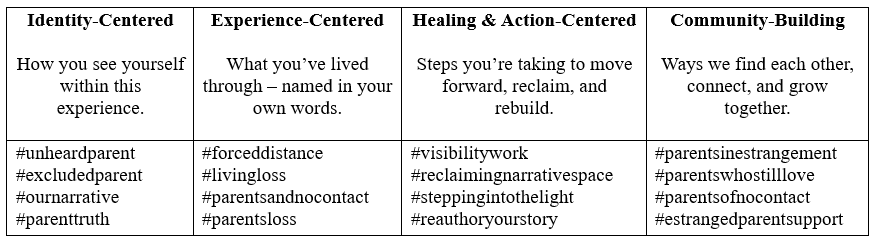
This room will be inviting, enlightening, and full of caring and hope. A room that gives us a place to speak without being miscast, corrected, or erased. A place where we can vent, hold each other’s hands, and find shoulders to cry on. Where sharing the smallest win is met with cheers.
How do we get these hashtags to take root? We use them – consistently. Choose 3-5 that stand out to you, and use them in your posts and comments, mixing existing tags with some new ones. Simply adding tags to your posts makes them part of the larger conversation.
When people read your posts and comments, they’ll be curious what those hashtags are for, and they’ll click on them. That’s how we spread our narrative and build our community.
This is how movements start - not with a shout, but with steady, repeated truth.
When our voices gather, even quietly, they begin to change the story.
You don’t have to post to begin.
Since hashtags are clickable on most platforms. When you click one, you’ll see other posts using the same tag. You can also search for a hashtag to see if it is already in use.
The easiest thing you can do:
click on a hashtag
read what others have shared
notice the patterns, the language, the emotions that surface
You can share, but you don’t have to
It’s a way to quietly step into a conversation. A way of seeing what has been hard to see when you’re carrying it alone. And over time, spaces and attitudes begin to shift. What once felt isolated starts to look shared.
*These hashtags were created for this community.


Just as hashtags help us find each other through language, there are rooms across the internet where estranged parents can find each other through presence.
Stepping into new spaces can feel vulnerable, especially when you’ve been misunderstood elsewhere.
Not every room is for everyone, but you will find ones that are a fit for you. Rooms where you can listen, be seen, be heard, and not be judged. Rooms where you can simply be you.
The Rooms That See Us
There are three types of rooms we can visit on the internet:
Room A - Where we just listen
Room B - Where we quietly observe
Room C - Where we can be seen
There is no particular order to these rooms. You can walk into whichever one you need at the moment.
You don’t have to take in everything you see here. Just notice what helps you understand the landscape a little more clearly.
Room A
There are rooms where listening itself is healing - where words arrive softly and remind us, we’re not alone. This is one of those rooms.
A quiet room for taking things in without pressure. A place to hear stories, insights, and conversations that help you feel less alone without needing to speak or participate. You can simply sit, listen, and let the words meet you where you are.
This room is for podcasts about estrangement, YouTube channels discussing family rupture, interviews with therapists or researchers, and listening to parents’ stories.
Podcasts to listen to:
Reconnection Club Podcast w/ Tina Gilbertson – Gentle, therapist‑led guidance for estranged parents - clarity without blame.
The Estranged Parents Podcast – Parent‑centered and grief‑aware; validates lived experience without sensationalism.
The Estranged Heart Podcast w/ Kreed Revere - conversations and interviews with estranged parents.
Videos that steady the heart:
Terrible, Thanks for Asking (select episodes) - Nora McInarny - a show that makes space for how it really feels to go through the hard things in life, and a community of people who get it
Patrick Teahan – select videos that focus on family dynamics and repair.
Conversations worth hearing:
Conversations with Pauline Boss – the founder of “ambiguous loss”- deeply relevant to estranged parents, delivered with warmth and clarity. https://www.ambiguousloss.com/resources/interviews/
On Being with Krista Tippett – Podcasts – Long-form, contemplative interviews about meaning, identity, grief, and what it means to be human.
Shared written stories:
Modern Love
The Atlantic’s Family Essays
Substack Writers - exploring grief, identity, and ambiguous loss
Research that honors lived experience:
Dr. Lucy Blake – Thoughtful & compassionate studies on family estrangement that honor the lived experience of parents.
Dr. Kylie Agllias – Her work is deeply human and compassionate. She doesn’t take sides – she takes care.
Dr. Kristina Scharp – She studies how people talk about estrangement, how narratives form, and how identity is shaped by rupture.
This room is here whenever you need a place to rest and simply let the words come to you.
When you’re ready to move from listening to quietly observing, there’s another room waiting for you.
Room B
This is where we read and listen to stories that mirror our own in some ways and differ in others. A room where we can observe how people make sense of estrangement, how they hold their pain, and how they talk about the people they’ve lost connection with.
In this room, we don’t have to speak. We’re simply noticing what resonates, challenges us, and helps us understand the terrain a little better.
This room holds places you can quietly observe from the doorway, helping you understand the broader conversation - what resonates, hurts, heals - without your participation.
Reddit communities to quietly observe:
These show the dominant narrative, the language adult children use, and the emotional climate - but they’re not safe for parents to speak in.
r/EstrangedAdultChildren
r/JustNoFamily
r/FamilyEstrangement
There are a few Reddit spaces where estranged parents gather, but they are small, quiet, and often inconsistent.
Parents don’t have a dominant space; they have scattered pockets. These are places we’ll need to get involved.
r/EstrangedParents - A small subreddit specifically for estranged parents. Activity is low, but the tone is generally supportive and reflective.
r/ParentsOfEstrangedAdultChildren - Another parent‑specific space. Again, small and quiet - but it exists, and some parents share their stories there.
r/Mommit (select threads) - Not an estrangement subreddit, but estranged‑parent threads appear regularly. These are mixed in tone - some supportive, some not.
Mixed-perspective Facebook spaces to look for:
These groups include all sides of estrangement and often have mixed perspectives. They allow parents to observe how different people talk about rupture, grief, boundaries, and reconciliation, without needing to comment.
Family Estrangement Support
Family Estrangement and Reconciliation Support Group.
Estrangement Support Group – All Perspectives Welcome
Healing from Family Estrangement
Estrangement forums where many stories live:
These are not parent‑specific and include a wide range of experiences. They offer a broader, more nuanced mix of stories, not just adult‑child narratives
Stand Alone Community Forum (UK)
Psychology Today comment sections on estrangement articles
Quora threads on family estrangement
Tiny Buddha forums (Family & Relationships section)
Comment sections that reveal how people make sense of rupture:
These are places where people publicly process estrangement. They show how people interpret estrangement stories, how they respond emotionally, and what narratives get reinforced.
YouTube comments on Dr. Ramani’s videos
Comments on “We Can Do Hard Things” episodes about family rupture
Comments on The Atlantic, NPR, or BBC articles about estrangement
Substack comment sections on writers who discuss ambiguous loss, identity after estrangement, etc.
This room gives us enough distance to see the patterns, the pain, the tenderness, and the misunderstandings that shape estrangement. We stand at the edges, letting clarity arrive in its own time. And when something inside us begins to shift - when we feel the faint pull toward connection - another doorway opens.
Room C
These are the rooms where our presence truly matters. Where we’re finally seen, heard, and appreciated for who we are. A room where we don’t have to explain ourselves to be understood. It’s peaceful, we don’t have to defend our grief or justify our love. It’s a place where we begin to feel the quiet strength that comes from being witnessed and witnessing others who carry a story like ours.
We don’t have to tell our whole story. We don’t have to defend ourselves. We don’t have to prove anything. We simply show up, as we are, and others meet us there – not with suspicion, but with recognition. We allow ourselves to be part of a conversation that includes us.
This room is about belonging, not performance. Visibility, not vulnerability. Connection, not confession. It’s where we begin to speak in our own words, at our own pace, in places that recognize our humanity. Not to convince anyone. Not to argue with the dominant narrative. But to exist in a place that was built with us in mind.
Room C isn’t a single place. It’s a collection of small, steady spaces where estranged parents can participate without being drowned out or dismissed.
These are spaces where estranged parents gather intentionally:
Parent-centered support groups
Online communities created by and for parents
Substack spaces where parents write and respond to one another
Small circles of parents who meet regularly, online and off
Hashtags that help us find each other without having to shout
Spaces that are built with us in mind. A place where our lived experience is not questioned, minimized, or reframed. It’s honored. We can speak without bracing, share without shrinking, and share stories that are part of the space.
These spaces are not loud or chaotic. You don’t need to brace yourself against others in the space.
In these spaces, you’ll feel like you’re:
Being met with understanding instead of suspicion
Being listened to instead of analyzed
Being recognized instead of erased
Being part of something instead of standing outside the door
There is no “right way” to enter these spaces. There is only your way. You can begin by replying to a post that moved you. Sharing a small reflection in a parent-centered group, posting a quote or thought with one of our hashtags. You can join a conversation where you feel safe. Even offering encouragement to another parent who is hurting brings us closer together.
And the more we show up in these spaces, even quietly, the more they grow and the more we reshape the landscape. They become steadier, warmer, and easier to find. They become places where new parents arrive and feel the relief of recognition. It’s not about being loud, it’s about being real. It’s about being a part of a community that sees the whole of you – the grief, the love, the confusion, the hope – and holds it with care.
For far too long, estranged parents have been spoken about instead of spoken with. These spaces are where that begins to change. And we’re the ones who can start that change. We will create space for complexity, for truth – for each other. And slowly, steadily, we’ll make space for ourselves.
So, sit back, take a deep breath, and relax.

Bringing it All Together
These rooms aren’t meant to replace our lived experiences, but help us see them more clearly. They remind us that our stories aren’t isolated events. They are a growing part of the larger human landscape.
We’ve explored the rooms we can build for ourselves - and taken an honest look at the spaces where we’re left out, shamed, or blamed. We need to understand this whole landscape to create spaces where we can build our narrative and challenge social norms.
We began with hashtags: how to grow the ones that already exist, how to create new ones, and strategies for using them to make our presence visible in society.
We learned about some rooms where we can just listen, one where we can observe, and ones where we can be seen. We know we can visit them as we feel ready. And that we don’t have to participate until we’re comfortable.
Each step brings us closer to ourselves and others who understand.
If you feel a pull toward one of these rooms, follow it. Trust that instinct, it’s pointing you toward connection.
There is no right moment, no required story, no perfect words. Just presence - truth - and you. Once you’re here, you’ll notice something: You’re not alone. You were never alone. You just needed this space where you could finally just be you.
Use those hashtags. Share a reflection. Add your presence to the places that welcome us. Take one step - any step - toward the spaces that see you.
Join us when you’re ready and help reshape the spaces that hold us - quietly, steadily, and powerfully.
We’ve got our backs.

Thank you for walking through these rooms with me. These conversations, rooms, and this growing landscape only matter because you’re here.
If any part of this issue stirred something in you – a memory, a question, a moment of recognition – I’d love to hear it.
If any part of it felt true, surprised you, or opened something inside you, please share it here. Your presence, stories, and reflections help shape the spaces we’re building together.
You can comment here or email me privately at thegrievingmommary@gmail.com.
Thanks again for reading,
The Grieving Mom – Mary
Images in this issue were generated by my imagination, with the assistance of AI tools that I use in my creative process.
Don’t forget to check out “Mary’s Shelf”; there are a few places to listen, observe, and honor the complexity of estrangement and the quiet strength of parents as they find their way.


A small collection of books, articles, and videos to feel less alone this week.
Mary’s Shelf
Articles
How Estrangement Has Become an Epidemic in America – Joshua Coleman and Will Johnson - Time Magazine – December 13, 2024 – A wide-angle look at the cultural forces shaping estrangement today, with attention to parents’ experiences. - https://time.com/7201531/family-estrangement-us-politics-epidemic-essay/
Estrangement is Never Easy or Straightforward – Rachel Fairbank - American Psychological Association – April 1, 2024 – Therapists can assist patients to identify relationships worth salvaging or help heal the pain of detachment - https://www.apa.org/monitor/2024/04/healing-pain-estrangement
Understanding the Heartbreak of Family Estrangement – HealthCentral – Kathleen Smith, Ph.D., LPC – October 5, 2022 - When one family member says “I’m done,” a powerful connection is broken. A look at a fairly common, but extremely painful, problem and advice to help you heal. - https://www.healthcentral.com/sex-and-relationships/family-estrangement
Podcasts & YouTube
The One You Feed Podcast & Coaching w/ Eric Zimmer –-interviews about healing, emotional resilience, and meaning-making. -
https://www.oneyoufeed.net/
We Can Do Hard Things w/ Glennon Doyle, Anamda Doyle, Abby Wambach – episodes on family rupture, boundaries, grief, and self-recognition. -
https://wecandohardthingspodcast.com/
Dr. Julie Smith w/ Dr. Julie clinical psychologist – clear, compassionate explanations of emotional patterns, boundaries, and relational pain. - https://www.youtube.com/DrJulie
Books (Purchase from your favorite book seller)
We Don’t Talk Anymore – Kathy Mccoy - October 3, 2017
An insightful and relevant new exploration of estrangement for both parents and adult children.
Done With The Crying: Help and Healing for Mothers of Estranged Adult Children – Sheri McGregor M.A. – May 3, 2016
Helps parents break free from emotional pain—and move forward in their own lives.
To fathers of estranged adult children - this book can help you, too.
Excellent post and resources. Thank you so much for putting this information together with a call to action to become involved. You are much appreciated!
Thank you, Mary! First, thank you for encouraging us to become more involved and to be heard. We must support each other, because when feeling powerless to change our situations (due to estrangement rules that prohibit discussion) our hope is eroded, and without hope - despair, and the darkest dark I have ever known. And second, thank you for the details of "how to." So many ways to advocate, and all the tools that I have never understood how to use!