
Narrative Therapy
You are not the problem (Part 1)


The theoretical foundation of narrative therapy is built on a simple but powerful idea: “People are not the problem; the problem is the problem.”
- Michael White
There are many facets that make up what is now known as Narrative Therapy. Every therapist engages with these ideas in somewhat different ways.
When you hear the term “narrative therapy,” it may refer to particular ways of understanding people’s identities. Alternatively, they might be referring to certain ways of understanding problems and their effects on people’s lives.4
Another interpretation concerns particular ways of talking with people about their lives and problems, or of understanding therapeutic relationships and the ethics or politics of therapy.
Humans are interpretive beings - we all have daily experiences of events that we seek to make meaningful. The stories we have about our lives are created by linking certain events together in a particular sequence over time and finding ways to explain or make sense of them. This meaning forms the story’s plot.
We give meaning to our experiences constantly as we live our lives, creating a narrative. A narrative is like a thread that weaves the events together, forming a story. We all have many, many stories about our lives and relationships that occur simultaneously.
For example, we have stories about ourselves, our abilities, our struggles, our competencies, our actions, our desires, our relationships, our work, our interests, our conquests, our achievements, and our failures. The way we have developed these stories is determined by how we have linked certain events together in a sequence and by the meaning we have attributed to them.
Widely used in family therapy, Narrative Therapy is a respectful, non-blaming approach to counselling and community work that centers people as the experts in their own lives. It views problems as separate from the person and assumes people have many skills, competencies, beliefs, values, commitments, & abilities that will assist them to reduce the influence of problems in their lives.1
Estrangement is uniquely suited to narrative therapy because, at its core, it is a story problem - a story that suddenly stops making sense. A story that cast you as the villain instead of recognizing you as a strong, courageous human being with your own story to tell.
Before the late 1970s and the rise of Narrative Therapy, psychiatrists and psychologists approached therapy as if the problem was part of their clients. Narrative Therapy changed that outlook forever.
Where did the concept of Narrative Therapy start?

Michael White – Narrative Therapy Begins

Michael White’s work sits at the heart of what we now call narrative therapy, but his presence in the field was far more human than theoretical
Michael White (1948–2008) was an Australian social worker and family therapist, widely recognized as the founder of Narrative Therapy. He began his career in probation and welfare work, later becoming a psychiatric social worker at Adelaide Children’s Hospital. In 1983, he co-founded the Dulwich Centre with David Epston, which became the central hub for narrative therapy practice and training.
Michael White’s work profoundly shaped contemporary psychotherapy. His ideas continue to be taught worldwide, and many practitioners describe his presence and contributions as transformative. Tributes highlight how his work helped people “discover better identities” and “build new places on which to stand.”
At its core, narrative therapy is a method that helps people separate themselves from their problems. It encourages individuals to rely on their own skill sets to minimize the problems that exist in their everyday lives.
His approach offered people a way to step out from under the weight of problem-saturated stories and reclaim a sense of authorship. This is why his work continues to matter.
“There is no ‘right’ way to go – merely many possible directions to choose from.”
– Alice Morgan (What is Narrative Therapy)
As Narrative Therapy began to take shape, it quickly gained attention in the therapeutic community. The approach resonated with many practitioners who were seeking alternatives to traditional, problem-focused therapies. Key milestones in the growth of narrative therapy included the 1990 publication of “Narrative Means to Therapeutic Ends”, which provided a comprehensive overview of the approach and its techniques.
The legacy of “Michael White: Pioneering Founder of Narrative Therapy” continues to inspire new generations of therapists and researchers. It offers those traveling the path of estrangement a renewed hope.

Personal Storytelling
The importance of storytelling in personal growth and healing cannot be overstated. Our lives are shaped by the stories we tell ourselves and others. These narratives influence our perceptions, decisions, and behaviors, often in ways we don’t even realize. By examining and reframing these stories, we can unlock new possibilities for change and personal development.3
White introduced the concept of “externalizing the problem,” a technique that encourages clients to view their issues as separate from their identity. This approach allows individuals to gain a sense of agency and control over their challenges, rather than feeling defined by them.
One of the most significant contributions of narrative therapy has been its emphasis on Narrative Therapy Externalizing Questions. This technique has proven particularly effective in helping clients separate themselves from their problems, creating space for new possibilities and solutions.
In his development of “re-authoring conversations,” White recognized that people often become trapped in dominant, problem-saturated narratives about their lives. Through re-authoring, clients are encouraged to identify and elaborate on alternative stories that highlight their strengths, values, and preferred identities.
Current applications of this therapy are diverse and far-reaching. From “Narrative Therapy for Grief: Rewriting Your Story of Loss*” to addressing complex trauma, the approach has demonstrated its versatility and effectiveness across a wide range of therapeutic contexts.
A strength of narrative therapy that aligns well with navigating estrangement has been its ability to evolve and incorporate new ideas. Some practitioners have experimented with timeline-based approaches, such as “Timeline Therapy: A Powerful NLP Technique for Emotional Healing.” This approach could add another dimension to narrative practice, allowing clients to explore their personal histories in different and insightful ways.
White & Epston’s work in developing “Narrative Means to Therapeutic Ends: Transforming Lives Through Storytelling” has provided therapists with powerful tools to help clients rewrite their life stories and overcome challenges.
Narrative therapy gives therapists two significant principles to work with:
1. Always maintain a stance of curiosity.
2. Always ask questions to which you genuinely don’t know the answers.
As we look to the future, narrative therapy continues to evolve and adapt. The process of “Deconstruction in Narrative Therapy: Reshaping Personal Stories for Healing” remains a powerful tool for helping individuals explore their histories in an increasingly complex world.

Mapping Our Stories
Mapping in narrative therapy is a powerful technique that brings our stories to life in a visual and tangible way. It’s like creating a roadmap of our experiences, emotions, and relationships - a way of seeing the path we’ve walked and the paths others have laid before us. Some of those paths were built from true narratives, and some from false ones.
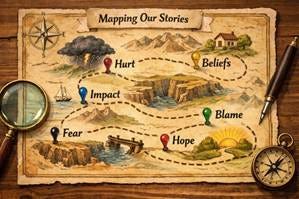
Mapping also helps us understand the complex landscape of our lives and re-navigate difficult spots with more clarity and self-compassion. Through mapping, we begin to notice the strength, knowledge, and tenderness we once overlooked in ourselves.
Each type of map, drawn by answering carefully chosen questions, serves a unique purpose, helping us explore different parts of our story.
§ Problem saturation mapping is a technique for exploring how a particular issue has influenced various aspects of our lives. This can be an eye-opening exercise, revealing the far-reaching effects of challenges we face.
§ Re-authoring conversations mapping focuses on our hopes and dreams for the future, and is at the heart of narrative therapy. These discussions focus on reframing our experiences and creating new, more empowering narratives.
§ Alternative story maps explore new possibilities and perspectives, and it’s where the magic of narrative therapy truly shines.
These visual tools give us a concrete way to engage with abstract experiences and emotions. As we map our experiences, we often discover moments of strength, resilience, or joy that don’t fit with our dominant narrative. These “unique outcomes” become the foundation for new, more empowering stories about ourselves.
We will delve deeper into mapping in part 2 of this series.

The Core Ideas
White and his long-time collaborator David Epston developed narrative therapy to address a specific problem in traditional therapeutic models that treated people as if the problem lived inside them. Their work emerged in response to the limitations they saw in pathology-based, expert-driven approaches and their desire to create a therapy that honored dignity, agency, and cultural context.
Working off White’s initial concept, “People are not the problem, the problem is the problem,” White and Epston developed the seven core ideas that formed the backbone of Narrative Therapy.
1. People Are Separate From Their Problems – this approach encourages individuals to externalize problems rather than internalize them, reducing shame and opening space for change.
2. Lives Are Shaped by Stories – viewing identity as shaped by the stories people tell about themselves, helping them re-author their stories to highlight strengths, values, and preferred ways of being.
3. Externalizing Conversations - helping people separate themselves from their problems. Externalizing conversations turn problems into entities that can be examined, challenged, and changed.
4. Re‑authoring Conversations – help identify alternative storylines, and build them into richer, more empowering narratives.
5. Re‑membering Practices - involves reconnecting with significant relationships, past or present, that support a person’s preferred identity.
6. Definitional Ceremonies & Outsider Witnessing – where outsider witnesses listen to a person’s story and reflect back on what resonated with them. This idea was inspired by the anthropologist Barbara Myerhoff.5
7. Attention to Power & Social Context - examining how cultural, institutional, and relational power shape the stories people live by.
Each core idea emerged as a practical response to the problems they saw:
Externalizing counters the collapse of identity into pathology.
Re-authoring conversations counter the idea that a single, problem-saturated story defines a life.
Unique outcomes counter the belief that problems are totalizing or inevitable.
Re-membering practices counter the idea that identity is fixed or solitary.
Definitional ceremonies counter the isolation and shame that come from problem-saturated stories.
Attention to power counters the invisibility of cultural, institutional, and discursive forces shaping people’s lives.
The client as expert counters hierarchical therapeutic relationships.
White and Epston weren’t just developing techniques. They were trying to create a therapeutic posture that refused to participate in the diminishment of people. Their ideas were as ethical as they were clinical. They wanted therapy to be a place where people could experience themselves with more dignity, spaciousness, and possibility.
Together, these ideas form a coherent worldview:
1. People are multi-storied.
2. Identities are shaped through language and relationship.
3. Therapy can help people reclaim authorship of their lives.
This way of addressing one’s narrative has proven to be a great therapy for the way estrangement destabilizes stories people once relied on to understand themselves. These stories are not just emotional experiences; they are narrative injuries that heal best through truthful remembering.

Estrangement Is a Story Problem
Our stories are shaped by three intertwined forces – events, people, and our own meaning-making – and narrative therapy treats each as an active shaper of identity rather than a passive background detail. Understanding how these forces work together gives your life a story. When viewed through a narrative therapy lens, estrangement reads like a ‘story problem.’
The story of who you are in relation to others
The story others tell about you
The story you tell about yourself after the rupture
These stories can become reduced, flattened, or rewritten without your consent. They can shrink your identity down to a single painful version of you: the “problem,” the “cause,” the “difficult one,” the “one who left,” or the “one who was left.”
Narrative therapy understands this collapse not as a personal failure, but as a narrative injury. When a story becomes dominated by hurt, blame, anger, or silence, it no longer reflects the fullness of who you are. It becomes a problem-saturated story, one that obscures your strengths, values, intentions, and history. It’s a story that can remove you from who you truly are.
How Events Shape Our Story
Events become part of our story not because they happened, but because of the meaning we attach to them and the sequence in which we place them. Turning points, repeated experiences, and even long silences all become threads in the plot we believe about ourselves. Estrangement often arrives as a narrative break, a moment that snaps, removes, or alters those threads, until your story no longer matches the one you thought you were living.
How People Shape Our Story
Other people act as co-authors, sometimes intentionally, sometimes without realizing it. Family stories, cultural expectations, and relational dynamics can create dominant narratives that overshadow your own. After a rupture, others may rewrite the story in ways that erase your intentions, your history, or your humanity.
How Our Own Understanding Shapes Our Story
We are not just characters in our story; we are also the interpreters. We link events together in ways that make sense to us, often through the lens of past experiences, fears, and inherited beliefs. After estrangement, it’s common to create a problem-saturated story: It must be me. I must have caused this. I must be the problem.
We need to reclaim the overlooked truths and throw out the myths that estrangement creates.
Narrative Therapy calls this process of reclaiming overlooked truths “re-authoring” - seeing your story with new eyes.
How do events, people, and personal meaning work together to form your story? They don’t operate separately; they braid together:
§ An event happens.
§ Someone interprets it for you (or against you).
§ You internalize that interpretation as part of your identity.
Over time, this becomes the story you live inside, even if it’s incomplete, distorted, or untrue.
Estrangement intensifies this process because it disrupts all three layers at once:
§ Events: the rupture
§ People: the shifting narratives others create
§ Understanding: the story you tell yourself in the aftermath
This is why estrangement feels like a narrative collapse and why narrative therapy is so well-suited to helping rebuild. It offers a way to step back from the inherited or imposed story and begin to see the landscape of your life with more clarity and compassion. It helps you identify the threads of truth, discard the false ones, and slowly rebuild a story that honors your dignity, your agency, and your lived experience.
Estrangement may have rewritten your story without your permission - but it doesn’t get the final word.

Bringing it to the Next Level
There are many fascinating areas of narrative therapy. We have only taken an overview here. The next two parts of my newsletter, “Narrative Therapy - You are not the problem,” will bring us deeper into the understanding and usefulness of this form of therapy.
In “Narrative Therapy - You are not the problem (Part 2)”, we’ll look closer at how and why mapping works and why the seven core ideas matter.
In “Narrative Therapy - You are not the problem (Part 3)”, I’ll discuss how we could use AI to map our path. We’ll look closer at that process, and I’ll share some of my path and how it opened my eyes to how helpful it could be. (This is not a substitute for therapy.)
If you’d like to begin exploring your own story through the lens of narrative practice, Michael White’s maps offer a set of questions designed to help people separate themselves from problems, rediscover neglected strengths, and remember the relationships that still matter. You can look up terms like “externalizing conversations,” “re-authoring conversations,” or “re-membering practices,” or visit the Dulwich Centre’s workshop notes for free exercises.
I hope this journey about Narrative Therapy helps you better understand how your internal story plays an important role in reshaping your path of estrangement.
Our path hasn’t ended, and it may never completely end. My hope is to help make that path a little smoother, a little straighter, and a little more bearable to walk.
Please share your thoughts, struggles, and hopes in the comments or email me privately at thegrievingmommary@gmail.com.
Continue to share your journey. Knowing the steps you have taken can help someone else take steps of their own. And sharing can make you a source of hope for others as they navigate their path.
Thank you for reading.
The Grieving Mom – Mary
Don’t forget to check out “Mary’s Shelf”, listing videos and readings of interest.

If you’d like to explore Narrative Therapy more deeply, the information below introduces Michael White’s ideas, demonstrates narrative practices, and explores how stories shape identity.
Articles
Michael White: Pioneering Founder of Narrative Therapy – NeuroLaunch Editorial Team – October 1, 2024 - https://neurolaunch.com/narrative-therapy-founder/
Stair Narrative Therapy: A Step-by-Step Approach to Personal Growth and Healing - NeuroLaunch Editorial Team - October 1, 2024 - https://neurolaunch.com/stair-narrative-therapy/
Timeline Therapy: A Powerful NLP Technique for Emotional Healing - NeuroLaunch Editorial Team - October 1, 2024 - https://neurolaunch.com/timeline-therapy/
Narrative Therapy for Grief: Rewriting Your Story of Loss - NeuroLaunch Editorial Team - October 1, 2024 - https://neurolaunch.com/narrative-therapy-for-grief/
Grieving Therapy: Effective Approaches for Coping with Loss - NeuroLaunch Editorial Team - October 1, 2024 - https://neurolaunch.com/grieving-therapy/
Podcasts & YouTube
All Things Narrative – “The Story of Narrative Therapy” (with Jill Freedman) — A foundational episode featuring one of the most respected narrative therapists in the world. Great for beginners and seasoned readers alike. -
Narrative Therapy Initiative – Narrative Revolution Series — A four‑part series with Steve Gaddis, exploring narrative ideas, identity, and meaning-making. Deeply reflective and grounded in White’s lineage. -
Narrative Therapy with Dr. Diane Gehart – A comprehensive lecture covering origins, techniques, and applications -
Introducing “The Narrative Metaphor” — A concise Dulwich Centre video introducing the core metaphor of narrative therapy. -
“What Is Narrative Therapy?” with Jill Freedman (1 hour) — A rich conversation with one of the field’s leading voices. -
Narrative Therapy with Families (CTAC) — A webinar on applying narrative therapy in family contexts. -
Books (Purchase from your favorite book seller)
Core Foundations (Michael White and close collaborators)
These are the books that define the field. They’re ideal for readers who want to understand the original maps, language, and worldview behind narrative practice.
Maps of Narrative Practice - Michael White (2007)
The clearest, most comprehensive articulation of White’s maps: externalizing, re‑authoring, re‑membering, definitional ceremonies, and scaffolding. Considered essential reading.Narrative Means to Therapeutic Ends - Michael White & David Epston
The classic text that introduced narrative therapy to the world. Dense but foundational.Narrative Therapy: The Social Construction of Preferred Realities - Gene Combs & Jill Freedman
A deeply respected companion to White’s work, offering clarity, examples, and philosophical grounding.
Accessible Introductions (Great for those new to narrative practice)
These books translate Narrative Therapy into everyday language without losing depth.
What Is Narrative Therapy? An Easy-to-Read Introduction - Alice Morgan
A gentle, clear introduction widely recommended for beginners.Retelling the Stories of Our Lives - David Denborough
A beautifully written guide to using narrative ideas in daily life, with exercises and reflections.The Narrative Therapy Workbook - Jneé Hill, LCSW
A practical, step-by-step workbook for applying narrative practices to personal challenges.
Applied and Specialized Narrative Approaches
These books extend narrative practice into specific contexts: trauma, solution-focused work, and integrated models.
Narrative Therapy in Practice - Various authors
A collection of applied chapters showing narrative work across different populations.Solution‑Focused Narrative Therapy - Linda Metcalf
A hybrid model that blends narrative and solution-focused approaches.Narrative Exposure Therapy - Schauer, Neuner & Elbert
A structured trauma-focused model rooted in narrative principles.

Citations
1 - Dulwich Centre Michael White - https://dulwichcentre.com.au/writings-by-michael-white/?utm_source=copilot.com
2 - Narrative Therapy Origins: Michael White and David Epston’s Groundbreaking Approach – October 1, 2004 - https://neurolaunch.com/who-developed-narrative-therapy/?utm_source=copilot.com
3 - Michael White Biography – (1948-2008) - https://www.goodtherapy.org/famous-psychologists/michael-white.html?utm_source=copilot.com
4 - What is narrative therapy? An Easy‑to‑Read Introduction – Alice Morgan – December 1, 2000 - https://www.google.com/search?q=What+is+narrative+therapy%3F+An+Easy+to+Read+Introduction&rlz=1C1ONGR_enUS1000US1000&oq=What+is+narrative+therapy%3F+An+Easy+to+Read+Introduction+&gs_lcrp=EgZjaHJvbWUyBggAEEUYOdIBCTEzNDdqMGoxNagCCLACAfEFBCE0GdwA_v0&sourceid=chrome&ie=UTF-8
5 - Barbara Myerhoff – Anthropologist & filmmaker - https://en.wikipedia.org/wiki/Barbara_Myerhoff