
Two Paths to the Same Silence
Defining Overt Alienation vs. Estrangement in a Culture That Blurs the Line


From a distance, alienation and estrangement look like the same silence. Inside that silence lives a very different truth, arising from distinct and often opposing mechanisms that serve different functions within the family system.
They do not operate in unison, but they can overlap in experience and are often wrongly used interchangeably.
Estrangement is rejection from a relationship due to lived experience.
Overt alienation, by contrast, is distancing shaped by someone else’s influence, pressure, or manipulation.
Overt alienation should not be confused with triangulation.
Triangulation occurs when a third party inserts themselves into a conflict to avoid direct communication or manage emotional tension indirectly. Overt alienation goes further. It actively creates or deepens distance between two people through pressure, distorted narratives, and manipulation.
In this issue, we’ll walk through estrangement and overt alienation. We’ll discuss where they overlap, where they diverge, when they work in tandem, and why the distinction matters.

Defining Estrangement
In estrangement, a child distances themselves from a parent by reauthoring the past - through unresolved needs, trauma, political or ideological fractures, or a relationship that feels painful, unsafe, or impossible. It’s a story written from the inside out.
It grows from lived experience, the moments when someone’s dignity was bruised, their boundaries ignored, their voice minimized. The distance that follows is often a form of self‑protection, a reclaiming of authorship after years of feeling written over, not external scripting or manipulation.1 It shows up as ambivalence, not splitting - the person can name both good and bad memories.2
Estrangement can take many forms - it can be:
· protective
· reactive
· impulsive
· deeply considered
· a tragic misunderstanding
Most importantly, estrangement isn’t always permanent.
Estrangement is the collapse or suspension of a relationship – whether temporary or permanent - when staying connected no longer feels emotionally sustainable. Modern culture increasingly frames distance as empowerment, while older generations often interpret it as abandonment.
An example of estrangement:
“The Slow Fade”
Lena spent years trying to maintain a relationship with her mother, who dismissed her feelings and criticized her choices. Every conversation left her feeling smaller. After one particularly painful holiday visit, Lena realized she always left feeling anxious and ashamed. She stepped back, not out of spite, but out of self‑preservation. No one told her to do it. She simply couldn’t keep abandoning herself to stay connected.
“I am choosing space because something in this relationship has harmed me.” - Lena
While estrangement emerges from lived experience and internal reasoning, overt alienation follows a very different path. Instead of arising from the relationship itself, the distance is shaped, influenced, or engineered by someone else.

Defining Overt Alienation
It is a narrative handed to someone, often a child, by another person’s fear, anger, or unresolved pain. The child begins echoing beliefs they never formed through experience but that were shaped, pressured, or manipulated by another person. The rejection is externally shaped rather than internally generated from the child’s own experience of the relationship. It reflects influence, loyalty conflicts, narrative distortion, or emotional coercion.
The behavior often follows scripts rather than memories. Instead of ambivalence, there is splitting - one person becomes “all bad,” while the influencing party becomes “all good.” The reasons for the rejection may sound rehearsed, developmentally inconsistent, or disconnected from the relationship’s actual history. This isn’t a flaw in the child. Rather, it may reflect the influence of a narrative that has gradually replaced the child’s own interpretation of events.
Overt alienation can involve:
pressure to choose sides
loyalty conflicts
repeated negative storytelling
distorted or exaggerated narratives
emotional rewards for rejecting someone
emotional consequences for staying connected
It’s the gradual re‑authoring of a relationship, whether intentional or indirect, and often affects the extended family as well.
An example of overt alienation:
“The Echoed Words”
After the divorce, nine‑year‑old Max began repeating phrases about his dad that sounded strangely adult: “He only cares about himself,” “He’s dangerous,” “He ruined everything.” Max had never expressed these ideas before. His mother frequently cried in front of him, saying she was “scared” of his father, despite no evidence available to Max that would explain those fears. Max eventually refused visits, not because of his own experiences, but because he had absorbed his mother’s fear and anger.
“I am rejecting you because someone else has told me who you are.” - Unknown
Even though estrangement and overt alienation arise from opposite forces - one internal, one external - they can look remarkably similar from the outside. This is where the confusion begins.

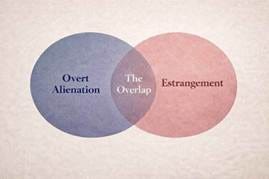
The Overlap
From the outside, overt alienation and estrangement can be almost indistinguishable. Both create silence, distance, withdrawal, and a breakdown in communication. Both can leave a parent on the outside of their own family system, unsure how the relationship unraveled or what the silence means. And both can be embedded in larger patterns of family marginalization, where one person becomes pushed to the edges of the emotional landscape.
But the overlap is surface‑level, not structural. What looks identical from the outside is driven by very different internal mechanisms.
Alienation and estrangement overlap in that they:
· cause the relationship to become suspended or fractured
· cause communication to stop or become strained
· shift roles, form alliances, and change emotional equilibrium
· can be misinterpreted because the visible behaviors look similar
· leave the rejected parent with unanswered questions - regardless of the underlying cause
This is why so many people - friends, therapists, extended family, even the culture at large - collapse the two into a single category. The outward behaviors look the same, and the emotional impact on the rejected parent can feel the same. But the inside is much different – alienation is imposed, estrangement is chosen.
Once a particular explanation takes hold, people naturally begin to notice evidence that supports it and overlook evidence that complicates it.
An example of overlap:
The Gray Zone - “Both Things Were True”
Sofia loved her dad but remembered his temper when she was younger. During the separation, her mom constantly reminded her of those moments, framing them as proof he was unsafe. Sofia’s own memories mixed with her mom’s narrative until she couldn’t tell where one ended and the other began. Her distancing was partly her own and partly shaped by someone else’s pain.
Her story shows how estrangement and alienation can blur together because real families live in the overlap between memory and influence.
“Two situations can look identical from the outside while being driven by very different internal dynamics.” – The Grieving Mom
But beneath those shared outward signs, the internal experience is profoundly different. The emotional logic, the narrative, and the psychological patterns diverge in ways that matter.

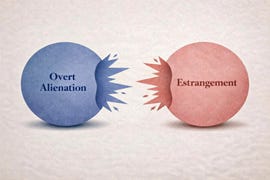
The Divergence
Although estrangement and overt alienation can look similar from the outside, the internal experience - the emotional logic driving the distance - is profoundly different. It comes from a different source, serves a different function, and follows a different emotional logic. Understanding these differences is essential because mislabeling one as the other leads to confusion, misplaced blame, and ineffective responses.
The core distinction is simple:
· Estrangement is distancing shaped by lived experience, created by the child’s own history with the parent.
· Alienation is distancing shaped by external influence, another person’s hostility, or narrative shaping.
From that single divergence, the rest of the differences unfold.
Alienation and estrangement diverge in that they involve:
· Different origins - estrangement arises from direct relational experience; alienation arises from someone else’s pressure, narrative, or manipulation.
· Different emotional patterns and complexity - estrangement shows ambivalence; alienation shows splitting and black‑and‑white thinking.
· How is the rejected person viewed - estrangement usually tied to specific experiences or unresolved patterns; alienation often flattened into a one-dimensional villain.
· Different narratives - estrangement includes specific memories; alienation often includes rehearsed or distorted explanations.
· The role autonomy plays - estrangement is usually framed as an independent decision, even when others support it; alienation often constrains independent interpretation.
· Different functions in the family system - estrangement protects the person who distances; alienation serves the emotional needs of the influencing party.
· Different impacts on extended family - estrangement may be selective; alienation often spreads to grandparents, siblings, and others.
· Different pathways to repair - estrangement requires repair, accountability, and relational healing; alienation requires addressing the influencing party.
In estrangement, the distance grows out of the history of the relationship. It reflects the history of the relationship. In alienation, the distancing is manufactured. It reflects someone else’s influence.
One is a boundary. The other is a distortion. The two processes may produce the same silence, but they do not arise from the same truth.
An example of the divergence:
“When the Paths Split”
Two mothers, Dana and Elise, each found themselves facing distance from their adult daughters. On the surface, their situations looked nearly identical - a sudden withdrawal, unanswered messages, holidays spent apart, and a painful sense that something had shifted without warning.
But beneath the surface, the forces shaping their daughters’ decisions could not have been more different.
Dana’s daughter, Maren, had been carrying years of quiet hurt. There had been recurring patterns: emotional shutdowns during conflict, a tendency for Dana to minimize Maren’s feelings, and a long history of unresolved tension. When Maren finally stepped back, it was not impulsive. It was the culmination of years of trying, hoping, and feeling unseen. Her distance was painful, but it was internally driven. It came from lived experience, accumulated meaning, and a desire to protect herself from repeating old wounds. This was estrangement.
Elise’s daughter, Talia, began pulling away shortly after entering a new relationship. At first, it was subtle; shorter conversations, less warmth in her voice, a new hesitancy when Elise asked ordinary questions. Over time, the shift became more pronounced.
Talia started repeating interpretations of her childhood that didn’t sound like her own. Moments that had once been neutral were retold with sharpness. Old memories were reframed with meanings Elise had never heard before.
The language Talia used didn’t match her history, her temperament, or the way she had always understood her relationship with her mother. It sounded borrowed - shaped by someone else’s lens, someone else’s certainty about what her past “really meant.”
There’d been no rupture between them, no escalating conflict, no long‑standing pattern of hurt. The distance wasn’t growing out of lived experience. It was being constructed, reinforced by an outside influence that steadily replaced Talia’s own voice with a different narrative.
Her withdrawal wasn’t internally driven. It was externally shaped. This was alienation.
From the outside, both mothers looked like they were living the same story: a daughter pulling away. But the inner architecture of each rupture was profoundly different.
Dana was navigating a wound created inside the relationship.
Elise was navigating a wound created outside it.
And that divergence - invisible at first - shaped everything that followed: the pace of the distance, the meaning of the silence, the possibilities for repair, and the emotional truth each mother had to reckon with.
This is what makes the distinction not only clinically important but also emotionally essential.
“Alienation strips away a person’s agency; estrangement is often the act of reclaiming it.” - Unknown
Even with these clear differences, real families rarely move in straight lines. Relationships unfold through timing, influence, vulnerability, and history. And sometimes the two processes don’t stay separate. They can interact, overlap in sequence, or even reshape each other.
That brings us to a more complicated but common reality: when the two processes operate together.

When They Operate Together
Alienation and estrangement do not arise from the same source - one is shaped by lived experience, the other by external influence. But in real families, the two processes can interact, piggyback, or compound each other. When this happens, the distance becomes harder for parents to understand, name, and make sense of.
Co‑occurrence often begins with a real rupture - a conflict, a painful pattern, a period of instability, or a strained relationship. That rupture creates vulnerability in the bond. A vulnerability that another person may exploit and step in with influence, pressure, or narrative-shaping, redirecting the child’s existing hurt into total rejection. What began as estrangement becomes intensified, distorted, or solidified through alienation.
Sometimes the sequence is reversed. A child may initially pull away because of external influence, but over time the distance creates its own lived experience - misunderstandings, absence, emotional drift - that begins to resemble estrangement. The original cause becomes tangled with the consequences.
When they operate together, parents often feel:
Confusion about the source of the rupture because the story no longer fits a single category
A sense of being erased twice - once by the distance itself, and again by the distortion surrounding it
Difficulty locating what is theirs and what isn’t complicates meaning‑making and repair
A feeling that the narrative has shifted over time - from lived experience to influence, or from influence to lived experience
In these hybrid situations, the silence isn’t the product of one mechanism but the interaction between them. A real wound may be exploited. A small conflict may be amplified. A legitimate concern may be redirected into a total cutoff. Or an externally driven rejection may, over time, create its own emotional reality.
When alienation and estrangement operate together, the parent isn’t dealing with one story but with two stories braided into one silence. Naming that complexity does not solve the rupture, but it restores clarity, and clarity is the first step toward understanding what happened and what might still be possible.
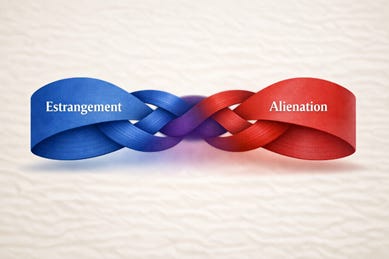
Understanding these differences isn’t about assigning blame. It’s about naming reality. When we can distinguish between these two paths, we can understand our own stories with more clarity, compassion, and accuracy.

Why Distinction Matters
The difference between estrangement and overt alienation shapes how people understand their own stories, make sense of their pain, and decide what healing is possible.
When estrangement is mislabeled as alienation, the person protecting themselves is accused of cruelty or brainwashing. Their boundaries are framed as manipulation, and their lived experience is dismissed or rewritten.
When overt alienation is mislabeled as estrangement, the person being manipulated is blamed for a choice they never made. The pressure, distortion, or loyalty conflicts are treated as personal choice rather than external force.
Both misinterpretations deepen the harm.
The distinction matters because it determines:
· What the distance means, whether it reflects lived experience or external pressure.
· Whether the work belongs inside the relationship itself, or in the surrounding system.
· How repair is possible through relational accountability, or through addressing influence and narrative distortion.
· How parents interpret their own story, whether they carry unnecessary shame or misplaced self‑blame.
· How professional misdiagnosis can lead to ineffective or even harmful guidance.
Naming the right experience restores clarity. It helps parents make sense of the distance and respond to it more effectively. It also resists cultural narratives that collapse all parent-child distance into a single story, erasing the complexity of real families.
The distinction matters because it gives parents back something they often lose in the silence:
An accurate understanding of what happened, and a path forward that fits the truth of their situation.
“When you name the right experience, you stop fighting the wrong battle.” - Unknown

What Research Says
About Estrangement
1. Estrangement is common and widely studied
Estrangement, especially parent-child estrangement, is documented across national surveys and qualitative studies. It is often rooted in:
Abuse
Conflict
Value differences
Boundary violations. This aligns with findings that estrangement is typically experience‑based rather than externally imposed. 6
2. Emotional responses differ by age
Young adults often report indifference rather than guilt or longing, challenging older narratives that portray estrangement as dominated by shame or pressure to reconcile. 6
3. Estrangement intersects with broader social dynamics
Estrangement can be influenced by political or ideological differences, with about 1 in 4 adults experiencing some form of family cutoff. 7
About Overt Alienation
1. Alienation is now recognized as a form of family violence
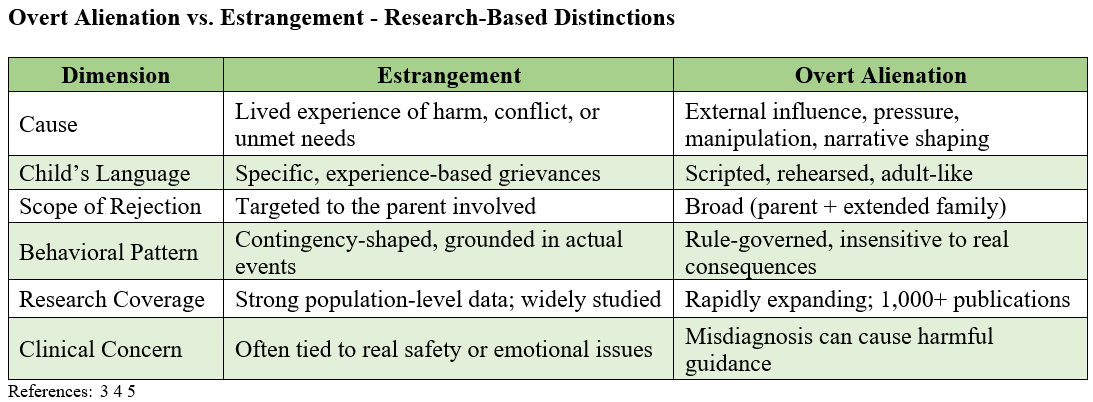
Parental alienation is described as an unjustified rejection of a parent, caused by behaviors such as demeaning comments, restricting access, or suggesting the child is unsafe with the other parent. These behaviors distort the child’s reality and create loyalty conflicts. 3
2. The field has grown dramatically
There are now 1,000+ books, chapters, and articles on parental alienation across 35 countries, reflecting a major expansion of research attention. 4
3. Behavioral markers distinguish alienation from estrangement
Recent theoretical work identifies observable behavioral markers that help differentiate alienation from genuine estrangement, including:
Scripted, adult‑like language
Globalized rejection (rejecting the parent and their entire family)
Rule‑governed behavior (child repeats narratives rather than responding to lived experience). These markers help reduce misdiagnosis in clinical and forensic settings. 5
4. Long‑term impact on children
Adults who experienced alienation as children often struggle with emotional regulation, trust, and self‑concept later in life. 3

A Moment for Narrative Reflection
Narrative therapy invites us to step back from the pain of the moment and look at the story surrounding the distance: who shaped it, what influences are present, and what meanings have been attached to it. These gentle questions are meant to help you reflect without blame or self-criticism.
1. Who authored the story that led to this distance?
2. Whose voice is loudest in the narrative - your child’s own, or someone else’s?
3. What values might your child be trying to protect by stepping away?
4. What pressures, loyalties, or influences might be shaping their rejection?
5. What alternative stories, about you, about them, about the relationship, have been overshadowed or silenced?
You don’t have to answer these questions. They’re included here simply to open space for clarity, compassion, and a more honest understanding of the forces at play. But if you’d like, you can share your answers in the comments to help other parents.

Bringing It Full Circle
When we look only at the silence, estrangement, and overt alienation appear identical because silence has no fingerprints. Two paths, both leading into the same dark center. But they do so from different directions and with different emotional terrain.
Naming those differences doesn’t solve the rupture, but it does something quieter and just as important: it restores clarity where confusion once lived. It helps parents locate themselves inside the story rather than feeling erased by it.
Understanding the distinction won’t change the past, but it can change how you move through the present - how you interpret the silence, how you hold your own history, and how you imagine what might still be possible.

Thank you for being here, for reading, and for reflecting. If this issue resonates, we’d all love to read your questions, your answers, or the parts of your own story it helped illuminate.
When you’re ready, we’re here.
Our community is one grounded in honesty, compassion, and the courage to name what’s hard. It’s a space grounded in information, supported by stories, and the occasional table to help illuminate your path to healing. The graphics are designed to illustrate the concepts as I see them.
We can support each other’s journeys by reading, reflecting on, and answering each other’s questions and comments. Without each other, we are just aimlessly wandering. Together, we’re guiding each other along.
You can comment here or email me privately at thegrievingmommary@gmail.com.
Thanks for reading, for thinking alongside me, and for allowing me to walk this disorienting path with you.
The Grieving Mom – Mary
Images generated by my imagination and AI tools.


For our community’s ongoing journey, these are the pieces I’m placing on the shelf this week
Mary’s Shelf
Articles
“I Didn’t Want Him In My Life”: The Pain & Peace Of Familial Estrangement - Tanyel Mustafa - July 1, 2025 - https://www.refinery29.com/en-au/estranged-family-members-relationships?utm_source=copilot.com
A Refinery29 article examining the emotional and relational consequences of estrangement, including how narratives shift over time. This aligns with the “two stories braided into one silence” theme.
The Roadmap to Healing Family Estrangement – Lawrence Rubin - The Roadmap to Healing Family Estrangement
A rich, clinician‑level conversation with Joshua Coleman about the rise of estrangement, cultural drivers, and the emotional architecture behind parent–adult child ruptures. For readers who want context, not blame.
Parental Estrangement: Finding Clarity in Therapy – Sarah Epstein LMFT – November 6, 2025 - https://www.psychologytoday.com/us/blog/between-the-generations/202511/parental-estrangement-finding-clarity-in-therapy
A nuanced look at how therapy helps adult children discern whether distance is protective or reactive. Good for the Divergence theme because it shows how internal vs. external drivers shape decisions.
50+ Resources for Estranged Family Members – June 11, 2025 - https://callinghome.co/blog/50-resources-for-estranged-family-members
A comprehensive, reader‑friendly hub of articles, videos, podcast episodes, worksheets, and scripts.
Podcasts & YouTube
Alienation, Estrangement, and the Path to Healing - Dr. Sue Cornbluth – May 2025 -
A rich conversation that directly addresses the differences between alienation and estrangement, the emotional toll on parents, and the long arc of healing. Perfect for readers wanting a compassionate, expert-led explanation.
Family Disappeared – Lawrence Joss – 2026 - Family Disappeared - Podcast - Apple Podcasts
A relationship‑focused podcast exploring estrangement, alienation, and erasure. The most recent episode covers parental alienation, generational trauma, and emotional self‑work.
Cut Off! Surviving the Nightmare of Parental Alienation & Estrangement - July 17, 2024 - https://shows.acast.com/the-christian-wellbeing-show/episodes/cut-off-surviving-the-nightmare-of-alienation-estrangement-1?utm_source=copilot.com
A therapist-led discussion that explores manipulation, influence, and the lived experience of being cut off. This pairs well with “When They Operate Together” section.
Research‑Based Resources
Resources from Parental Alienation Study Group (PASG) - https://keepyourlovealive.org/resources-for-parental-estrangement?utm_source=copilot.com
Free research summaries, videos, and educational materials on distinguishing alienation from estrangement. Excellent for readers who want evidence-based clarity.
Erasing Family Documentary - 2020 · 1 hr 33 min - https://tubitv.com/movies/528013/erasing-family
Additional resources at
https://erasingfamily.org/
Free to stream, with accompanying toolkits and articles. It focuses on the emotional and psychological impact of alienation on families.
Books (Purchase at your favorite book seller)
Parenting Under Fire: How to Communicate with Your Hurt, Angry, Rejecting, Distant Child – Amy J.L. Baker PhD, Paul R. Fine LCSW – August 15, 2023
Teaches parents of children of all ages who are hurt, angry, rejecting, and distant (HARD) how to effectively and empathically communicate through a variety of effective and empathic strategies.
Children who are hurt, angry, rejecting, and distant (HARD) can be challenging to parent. They can be rude, uncooperative, and disagreeable. They are hard to relate to or connect with, and they can appear to be hardened to the love and guidance of their parent.

References
1 - Behavioral Markers of Alienation vs. Estrangement: A Functional Analysis Framework – Rob Spain, BCBA, IBA, February 16, 2026 - https://reunifyscience.com/research/2026-02-16-behavioral-markers-alienation?utm_source=copilot.com
2 - Measuring the Difference Between Parental Alienation and Parental Estrangement: The PARQ‐Gap – William Bernet – 2020 - https://www.academia.edu/79580941/Measuring_the_Difference_Between_Parental_Alienation_and_Parental_Estrangement_The_PARQ_Gap?utm_source=copilot.com
3 - Parental Alienation and Reunification Therapy: An Evidence-Based Review - Ghia Townsend – August 8, 2025 - https://torontopsychologicalservices.com/parental-alienation-and-reunification-therapy-an-evidence-based-review/?utm_source=copilot.com
4 - Parental Alienation - Jennifer J. Harman, William Bernet, Joseph Harman – April 2019 - https://www.jstor.org/stable/48553261?utm_source=copilot.com
5 - Behavioral Markers of Alienation vs. Estrangement: A Functional Analysis Framework - Rob Spain, BCBA, IBA – February 16, 2026 - https://reunifyscience.com/research/2026-02-16-behavioral-markers-alienation?utm_source=copilot.com
6 - Family Estrangement and Its Effects on Adolescents and Young Adults - Greg Chen, DO – October 2025 - https://www.jaacap.org/article/S0890-8567%2825%2901491-1/fulltext?utm_source=copilot.com
7 - Overview of Family Estrangement and Political Ideology - Scott Valenti / Grok Prompts & Redirects – October 21, 2025 - https://keepyourlovealive.org/overview-of-family-estrangement-and-political-ideology?utm_source=copilot.com
Two points
Alienation is not as well researched as you may think . It is much more controversial and occurs only by definition in a custody / divorce context . There is a very large lit making this point - esp Drew and Mercer -‘ challenging parental alienation’
These are not ‘ children . They are adults . Using the term child tends to relieve them of accountability despite external influence. Adults are responsible for their choices . There is no other context where adults get this kind of pass . We were all children once with a history good and bad . Imho the diff is who is expected to have a conscience - not who has agency .
A distinction worth examing. Thank you.